Electoral behavior and political rules
Why we vote when we vote, how rules change outcomes and what happens to representation. Compulsory and voluntary voting, electoral systems, party switching and gender parity.
HomeResearch
I study political and electoral behavior, institutions and social change in Chile, with data and quantitative methods.
Why we vote when we vote, how rules change outcomes and what happens to representation. Compulsory and voluntary voting, electoral systems, party switching and gender parity.
How schools, families and the 2019 social uprising shaped the way young Chileans vote, protest and trust institutions.
Natural language processing of political texts, to measure not only what leaders say but how they say it.
Alcohol’s harm to others in Chile, compared with Australia. That work led to articles and a book chapter with the World Health Organization.
Latest post|No. 2|November 22, 2026
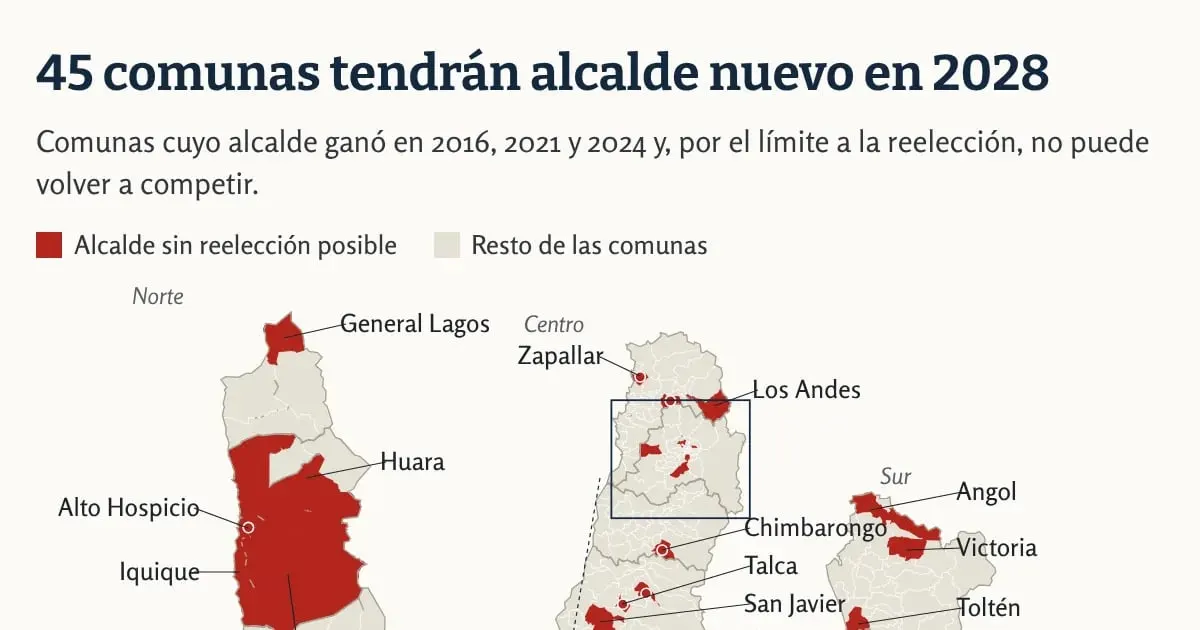
El límite a la reelección deja fuera de la próxima municipal a 45 alcaldes que ganaron en 2016, 2021 y 2024. Un mapa de las comunas abiertas, de la fuerza con que llegaron sus alcaldes y de quiénes asoman para reemplazarlos.
No. 1|November 22, 2026
Article|Working paper, October 2026|With Gonzalo Müller
What structures the vote for candidates who grow outside the established blocs? In Europe and the United States, economic decline and the lack of university degrees tend to fall on the same places. Chile pulls them apart. Using data from 339 municipalities, the paper shows that the share of young adults with a university degree sets Parisi apart from both the right and the left, that his vote rises with municipal income up to the 98th percentile, and that the pattern holds in 2021 and 2025, under voluntary and compulsory voting.
Book|In preparation
How Chilean politics changed after the 1988 plebiscite, told through surveys and election results. For twenty-four years, rules that forced cooperation and shared ideas sustained a democracy of agreements. That balance broke in 2013 and the same design began to produce gridlock. Voters did not change their ideas, they changed their options: that is the great realignment.
Book|Early stage
How roads changed the way we meet, work and prosper. Roads shortened the distance between families and cities, opened markets where there had been isolation and changed the course of entire countries. The book follows two stories: the great American interstates and the highway concessions that, since the 1990s, redrew the map of Chile.
2026
Uses school-attendance records from the October 2019 protests and the 2016 ICCS civic education survey. An open classroom climate is associated with more conventional and legal non-conventional participation, while a respectful school environment and parental involvement are associated with less protest-related absence.
2026
Political participation and young people: a view after Chile’s social uprising
Logistic models on 7,124 respondents aged 18-29 from the 10th National Youth Survey (2022). Age increases voting but not protest or party membership; education and progressive values raise both voting and protest; political interest and ideology are the main drivers.
2024
Proposes NLP markers of populist rhetoric in presidential speeches and tests them against the Global Populism Database for left-wing leaders in Spanish-speaking Latin America. In-group and emotional content, the future tense and conditional connectors are more frequent in populist speeches.
2024
Electoral rules and gender representation: the “zebra” mechanism in Chile’s 2021 Constitutional Convention election
Polling-station regressions estimate that alternating women and men on the ballot raised within-list support for women by about 6 points, and by about 2 points against a matched sample of the concurrent municipal council election.
2024
Social determinants of combined use of alcohol and non-prescription drugs among older adults in Chile
Using SENDA’s 2021 survey of older adults, 12.8% combined alcohol with non-prescribed medication; men with less social support and living without a partner were most likely to do so.
2016
Alcohol’s harm to children and families in Chile: a population survey
In a national survey of 1,500 adults, 10.5% of those living with children said someone’s drinking had harmed a child, most often through verbal or domestic violence and unsupervised homes.
2015
Compares Chile with Australia: heavy drinkers inside the household reduce Chileans’ health and well-being, and those outside it have a smaller negative effect, a pattern that differs from the Australian one.
2015
Alcohol’s harm to others: a population study in Chile
A 2013 household survey of 1,500 urban Chileans: about one third reported negative effects from someone else’s drinking, most often verbal abuse, fear at home and family problems.
2025|Book
2024|Chapter
2024|Chapter
2022|Dissertation
2020|Book
2019|Chapter
2017|Chapter
2026
2026
2026
2026
2026
2026
2025
2025
2025
2025
2025
2024
2023
2023
2022
2020
2017
2016
2015