Newsletter|November 22, 2026
HomeChile, explained
Short answers, with data, to the questions I am asked most often about Chilean elections, Congress and public opinion. Each one comes from my own research, including my forthcoming book on how Chilean politics was reordered between 1988 and 2025.
Voter turnout in Chile
% of registered voters who voted
The short version
Chile moved from compulsory to voluntary voting in 2012 and back to compulsory voting in 2022. Turnout went from about half of the electorate to about 85%, which makes the country an unusual laboratory for the old question of why people vote.
Newsletter|November 22, 2026
Newsletter|November 22, 2026
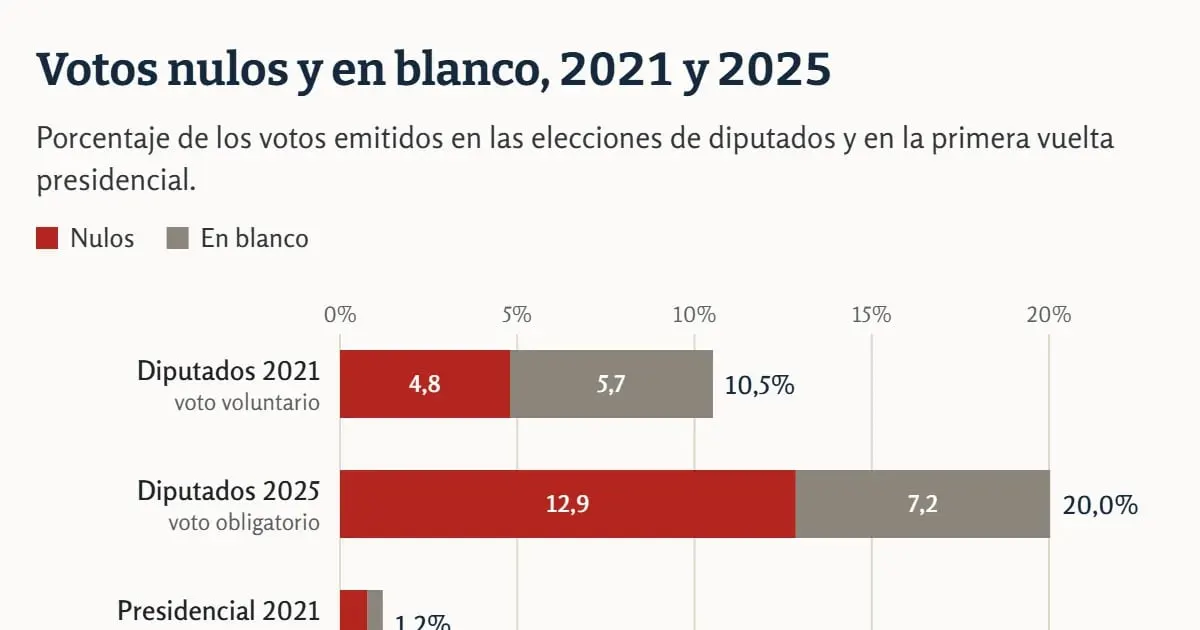
Yes. Chile has changed its voting rules twice in a decade. From 2012 registration became automatic and voting voluntary, and turnout fell to about half of the electorate: 49% in the 2013 presidential election and 47% in 2017 and 2021. Compulsory voting returned for the September 2022 constitutional plebiscite and was then made permanent. Since then about 85% of registered voters turn out: 86% in 2022 and 85% in the 2025 presidential election.
In the newsletter (in Spanish): Qué dice la ciencia política del voto obligatorio en Chile
Source: Servel, official results.
My 2015 working paper compares the 2008 and 2012 municipal elections, the last under the old rules and the first with automatic registration and voluntary voting. Chile went from a small, older electorate that was obliged to vote once registered to a universal electorate in which voting was optional, which is why the country is an unusual laboratory for the question of why people vote.
In the newsletter (in Spanish): Qué dice la ciencia política del voto obligatorio en Chile
Source: Working paper, 2015 (Spanish).
Less and less. Comparing presidential and deputy votes polling station by polling station, at least 27.4% of votes in 2021 and 25.8% in 2025 went to a presidential candidate and a different list for the Chamber, up from 9.1% in 2013 and 12.0% in 2017. These are lower bounds, since splits that cancel out within a polling station are invisible. Presidential coattails remain large: within the same municipality, one more point for a presidential candidate brings more than half a point to the deputies of their list.
Source: El gran reordenamiento: change and politics in Chile, 1988-2025 (book in preparation); Servel results by polling station.
No. Of the 2,742 candidates in Chile’s 2017 elections, 54% had already run in some earlier election. The figure comes from matching their names against more than 40,000 candidacies since 1989.
Source: El Mercurio, 12 November 2017.
Far fewer do. In CEP surveys, 68.5% of Chileans identified with a political party in 1993 and 16.2% in 2021. At the same time the party system fragmented: the number of parties with seats in the Chamber of Deputies went from 8 in 1989 to 22 in 2021, and the minimum number of parties needed to form a majority went from 2 to 5.
Source: El gran reordenamiento: change and politics in Chile, 1988-2025 (book in preparation); CEP national surveys.
In how it votes, yes. Across the six legislatures studied, the share of divided roll-call votes in the Chamber of Deputies nearly doubled, from 38.9% to 72.2% in 2022-2026. Deputies describe themselves the same way: the share who place themselves at the center of the left-right scale fell from 69.6% in 1993-97 to 38.9% in 2022-26, while those at the extremes rose from 8.7% to 34.7%. What grew is disagreement inside each coalition, not the distance between coalitions, and the Chamber still votes along a single left-right dimension.
Source: El gran reordenamiento: change and politics in Chile, 1988-2025 (book in preparation); Chamber of Deputies roll calls and PELA surveys of legislators (Universidad de Salamanca).
In a study of more than 6,600 roll-call votes in the Senate and the Chamber of Deputies between 2022 and 2025, with a cohesion index for each party, the Republican Party and the Communist Party were the most cohesive. Parties of the Chile Vamos and Socialismo Democrático coalitions were among the least disciplined.
Source: Faro UDD study with Jorge Cordero Frigerio and Raúl Opazo Fuentes (Spanish); El Mercurio, 28 March 2025.
Not according to the timelines. Comparing how long bills took to become law from 1990 to 2024, a law took 778 days on average under President Boric, within the range seen since the Lagos administration. The data do not support the claim of unusual obstruction.
Source: El Mercurio, November 2024.
The rules have not changed since 1990, but their use has. The Chamber of Deputies filed 0.6 political-administrative impeachments a year on average between 1991 and 2017, and 2.2 a year between 2018 and 2025. My hypothesis is that the end of the binomial electoral system multiplied the parties competing for visibility: each additional effective party is associated with about 1.5 times the expected rate of impeachments, even controlling for presidential approval.
Source: Open research idea, with data.
Yes, modestly. Alternating women and men on each list, the “zebra” mechanism used in the 2021 Constitutional Convention election, raised within-list support for women by about 6 points, and by about 2 points against a matched sample of the concurrent municipal council election.
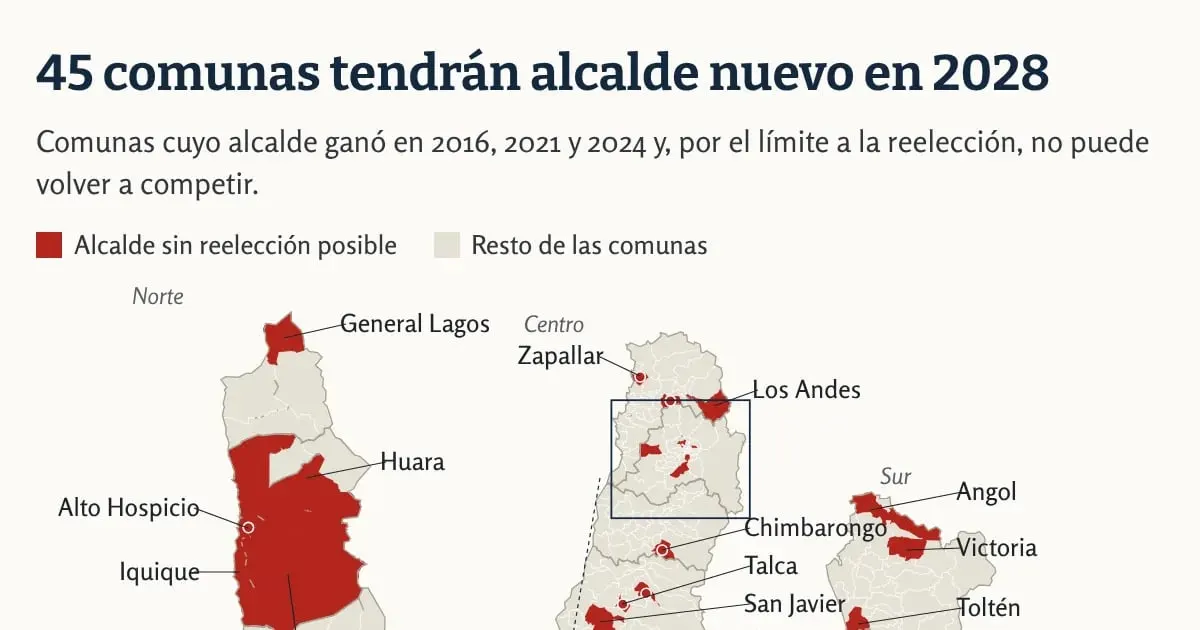
Chile introduced term limits for mayors, councillors and legislators in 2020. By my estimate with Servel data, 28% of incumbent mayors (98 of 345) could not run again, a larger share than among councillors or deputies. That makes the reform a good natural experiment for studying municipal hiring and spending when a mayor faces no next election.
In the newsletter (in Spanish): Las 45 comunas que tendrán alcalde nuevo en 2028
Source: Open research idea, with data.
Yes. Combining school-attendance records from the October 2019 protests with the 2016 civic education survey (ICCS), I find that an open classroom climate is associated with more conventional and legal non-conventional participation, while a respectful school environment and parental involvement are associated with less protest-related absence.
Source: Youth, 2026.
Because many of those who had approved the process changed their vote, and almost nobody moved the other way. In the ELSOC panel, which interviews the same people over time, 38.2% of those who said they voted Approve in October 2020 said they voted Reject in September 2022, while 96.9% of 2020 Reject voters rejected again. The same people also moved to the right on the left-right scale between 2019-20 and 2023-24, and that shift was already complete before the September 2022 plebiscite.
Source: El gran reordenamiento: change and politics in Chile, 1988-2025 (book in preparation); ELSOC panel survey (COES).
For some citizens democracy is not a set of procedures but a system that must deliver results and security. With the 2023 Latinobarómetro (19,205 respondents in 17 countries) I identify five conceptions of democracy; the anti-institutional profile, 13.5% of the sample, is more tolerant of institutional erosion, although that tolerance falls when the person expects their economic situation to worsen.
Source: Open research idea, with data.