HomeProjectsCongress Simulator
Congress Simulator
A teaching method for legislative politics. Every student becomes a member of Congress with a party, a district and a secret card with their party’s goals. They negotiate, keep or break deals and vote from their phones, while the instructor runs the session and the room watches the chamber fill in real time.
The app is in Spanish. Students join at mafernandez.cl/congreso with the code shown on screen.
Why a simulation
Students learn the rules by living with them
Textbooks explain agenda power, coalition building and party discipline. In the simulator students feel them: they discover that no party can win alone, that whoever controls the agenda shapes the outcome, and that a vote good for the party can cost a legislator their seat.
The debrief turns the session into theory. Each result can be read against the literature on legislative bargaining, veto players and electoral incentives, and each effect on the national index states its assumption and its source, from Chilean fiscal law to North and Weingast (1989).
The scenario
Chile, 2027: a rare-earths windfall
Fictional parties, real dilemmas. Windfall revenue forces Congress to choose between saving, cash transfers to families, decentralization and faster permits for investment, with a budget of 100 that cannot pay for everything.
| Bill | Cost |
|---|---|
| Stabilization fund | 40 |
| Universal winter bonus | 50 |
| Regional royalty | 30 |
| Permits reform | No cost |
Fiscal rule: a bill that costs more than the remaining balance is inadmissible and fails without a vote.
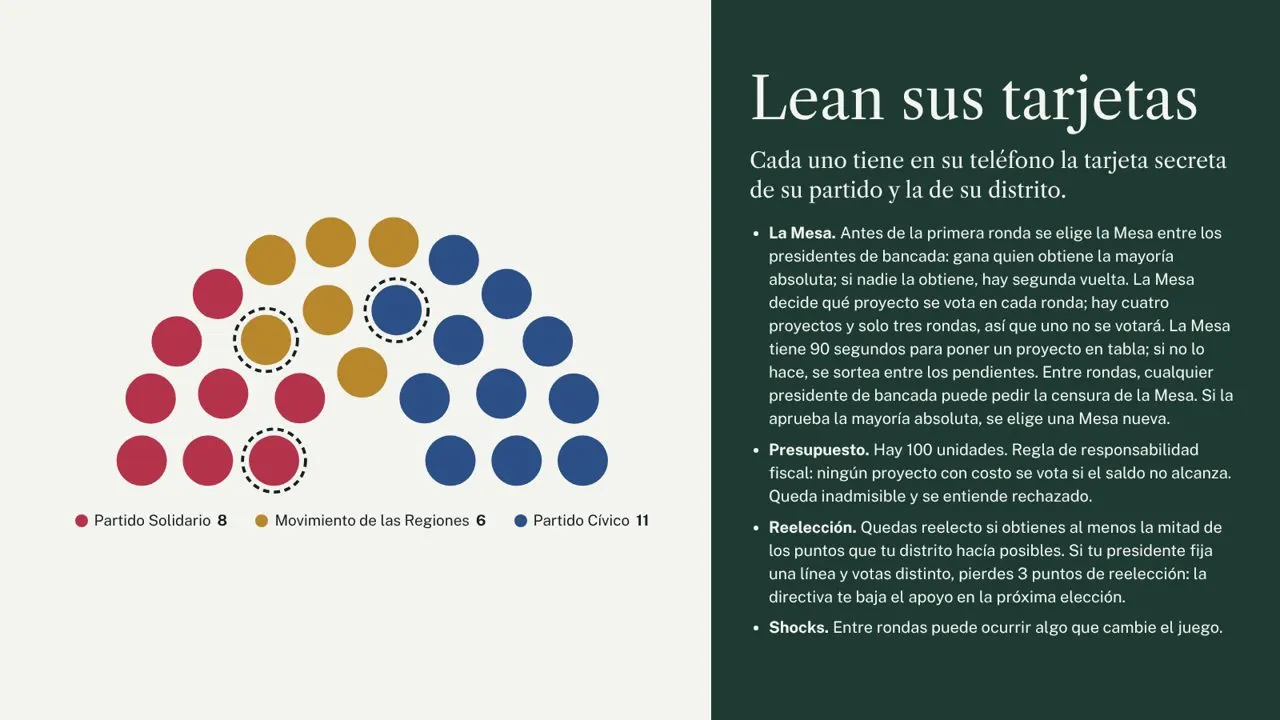
- Three parties. None has a majority on its own, and any two of them do.
- The presiding board. Elected among the caucus leaders, it decides which bill comes to a vote. There are four bills and only three rounds, and the board can be censured.
- Districts. The mining north, urban Santiago, or Biobío and the south. Re-election depends on how each member votes.
- Shocks. Between rounds the price may fall, an earthquake may strike or a security crisis may break out.
In class
How a session runs
- Create the session and note the PIN, which lets you resume from another device.
- Project the room screen, with the address, the code and a QR code.
- Form the caucuses. The app assigns party and district at random.
- Appoint caucus leaders and open the election of the presiding board.
- In each round the board proposes, the class negotiates and votes against the clock.
- At the end the app reveals re-elections, party goals and the national index, and exports the results.
The instructor can run everything from a phone.
What it measures
Three scores that rarely agree
Each member wants re-election, each party pursues its secret goals, and the country moves up or down an index of freedom and progress that nobody sees until the end. The tension between the three is the lesson.
Where it has been used
From a conference to the classroom
I first used it at the XXI Conference on Political Science and Public Policy of the School of Government at Universidad del Desarrollo, in November 2026. It runs in the browser and is free to use. If you would like to run it in your class or build an English version together, get in touch.